Shades of Coke Blind Taste Test
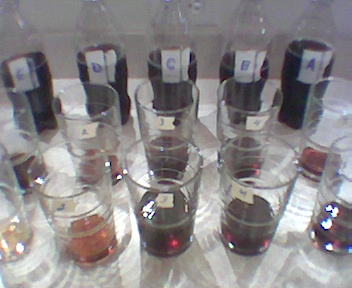
On Sunday Kate Bauer and I ran and participated in a double blind random taste test of the various shades of Coca-Cola. Into numbered glasses Kate poured the samples from bottles whose labels I'd replaced with lettered labels. The samples we included were:
- Coke
- Diet Coke
- Diet Coke with Splenda
- Coke C2 (already hard to find!)
- Coke Zero
Kate was 3 for 5 with only Coke and C2 transposed. I got only one of them right (everyone knows the gasoline flavor of Diet Coke). From this we can conclude that either Kate's got a much better palate than I do or that she drinks a lot of Coke when I'm not looking.
MTN Televised Scrabble Archive
I've been hooked on MTN's televised scrabble since Kate Bauer and I stumbled across it a few weeks back. The only on-line mention I can find of it is an old review in a student paper.
I'm thinking of getting a group of folks together to play as a team semi-regularly, but while that's getting setup I decided to start archiving the games, because that's the sort of thing I do, I guess.
I started out by looking to see if there already was a standard scrabble game notation. There are a few, but none of them are particularly well thought out. The most commons seems to be the log2 format. It's human readable, but pretty fiddly syntax wise.
Last weeks game as a log2 file starts like this:
Hamil                                   Mpls
  8h  CARP             +16   16  MIXIWOD   i7  WAX             +25   25
   h8 COPE             +17   33  IIMODTL 11e   MODEL           +16   41
  9g  FOX              +17   50  IITEYTG 10d   GEY             +28   69
In addition to creating a log2 file for the game, I created a first cut at an on-line HTML visualization as found here: https://ry4an.org/scrabble/games/2005-06-21/ The image on that page:

was created with the help of the board display tool by Graham Toal.
Once I get that page into a format I like, I'll probably create a CGI that converts log2 files to HTML visualizations on the fly. I, however, definitely don't have time for something like that now.
Comments
I think this idea is really cool. -Hamil
Netflix Self Annotations
I'm a happy Netflix user. Before I used Netflix I used to maintain a list of movies I wanted to see. Now I just use my Netflix queue for the same purpose. The only problem with my new system is by the time a recommended movie goes from the back of the queue to the front, about a year, I've long since forgotten who recommended it.
If Netflix offered a way for me to put a little note next to my own queue entries, I'd better be able to track who recommended movies or just why they made it on to my queue in the first place. Netflix does offer a feature they call their two cents system wherein you can write reviews of movies, which other members on your friends list can view. That's not really what I'm looking for though. I just want some space I can make notes to myself -- not for others.
I've suggested this to Netflix, but I've never received a reponse to a suggestion sent to them, so I'm not holding my breath.
P.S. If you're the person who recommended The Apostle to me, I now hate you.
Poker Timer DVD
There's a ton of poker time software out there and even some nifty looking dedicated hardware. At the games I attend we'll usually use a computer for the timing, but often there isn't one in the room and no one wants to bring over a laptop. However, there is almost always a TV with DVD player in whatever room gets temporarily re-purposed as the game room.
That got me thinking that a DVD that could serve as a poker timer would work in all the rooms in which we play poker and would offer these other benefits:
- large display
- easily paused using a remote
- doesn't require a computer
- simple operation
- audible alert when the blinds increase
- cheap to produce
Tournaments often last four hours or more, but a DVD can hold that much video using a variable bit rate encoding so long as the image doesn't change a great deal, and a simple count-down timer image wouldn't change very much at all.
The elapsed time per round, round number, and time remaining in the round would all be numbers on the video display, but the actual blind values, which tend to differ from tournament to tournament, would be best contained in the closed captioning track.
DVDs can contain zero or more closed captioning tracks each of which contain screen location information and text which is overlaid on the video. Putting different blind levels on different tracks allows the tournament director to easily adjust the blinds to whatever he or she prefers.
Creating the DVD would be a simple matter of transcoding computer output into a variable bit rate DVD-ready video stream. The computer output time display could be easily created using simple computer graphics programming, flash, or even javascript and HTML.
I suspect if someone took the time to put together such a DVD it could be sold in poker stores, game stores, and online for way more than the less-than-a-dollar production cost. Go do it, and I'll buy one.
Comments
It looks like someone did start making something like this (before I posted). Their implementation looks very nice: http://www.homeseriespoker.com -- Ry4an
May Wrap-Up
The policy here at the UnBlog is that I only write up things I've created -- not just things I've seen. Last month, however, most all my creative output went into work, with very little time and energy left for side projects. I've got a few nearing completion, but nothing worth writing about yet.
I did manage to get a few small projects done -- some of which involved a little ingenuity:
- installed a ceiling fan in a 1920s era home -- with creative ceiling patching and wiring required
- disassembled and diagnosed my broken washing machine
- repaired a broken sandal using the sheet bend and two-half-hitches
- painted a room
Hey, it's not much, but neither is my quantity of available free time.
Comments
what a lucky person to have all those projects done for them. who ever would that be??? since of course you don't wear sandals or have a 1921 house. -- Kate Bauer
It's a secret. -- Ry4an
Campfire Frozen Pizza
Last weekend I was camping and the person buying the food bought frozen pizzas. I couldn't think of any good way to cook them until I saw we had some aluminum foil. We defrosted the pizzas and cut them into slices. Slices were places face-to-face, wrapped in two layers of tin foil, and then tossed into the coals of our fire. After ten minutes or so they were fished out, and they'd turned into perfectly palatable pizza-pocket-alikes. It's not good camping food, but its better than raw frozen pizza.
Comments
but was it freschetta rising crust pizza? that stuff is good. especially with pre-packaged caesar salad.
Guidelines For Better Directions
When getting or giving directions I always prefer a map to written directions. Maps are great because they don't become useless if you make a wrong turn. With a good map you can always find where on it you are and can always build a new route to your destination.
Unfortunately, one can't always produce a map on the spot -- especially a good map. In those cases you have to fall back on written directions. I've given and received plenty of directions, some good, but mostly bad. I'm thinking a list of guidelines to use when vetting directions could help.
- Use sequences when available
- Provide unmistakable backstops ("if you've hit the river you've gone too far")
- Provide both cardinal, N/S/E/W, and left/right directions
- Give distances when available
- Try to identity streets as they're labeled, not as they're referred to locally
- Eschew landmarks, they're single points easily missed
Probably the only one that needs an explanation is the first, which is certainly the most important. Exit numbers, mile markers, and street numbers all provide good sequences that can be used to easily imbue directions with some great properties they didn't previously have:
- sequences let you know if you're going in the right direction
- sequences let you know if you've gone too far
- sequences allow you to estimate how much further you need to go
Street numbers are probably the most underutilized navigational aid -- even the on-line mapping systems don't use them despite having block-by-block street number data. "Turn left/west on Washington after the 200 block of 2nd Ave" provides so much much usable data.
I know all the points in the list are pretty obvious, but if even half of them were met by the directions I've tried to follow in the past a lot of time, gas, and worry might have been saved. I guess the message is to take 5 minutes longer when giving directions to save much more time when driving.
Comments
Cell phones are wonderful when in doubt or unsure.
CVS Commit Blocking
When editing source files checked out from CVS I sometimes want to prevent them from going back in to source control without further edits. Until now I've just used // FIXME comments and have tried to remember to grep for FIXMEs before committing the files back.
Problem is others use FIXME comments, and sometimes I forget to grep. So I've tweaked our CVSROOT files to prevent custom FIXME tags from going in to source control.
I appended this line to CVSROOT/commitinfo:
ALL $CVSROOT/CVSROOT/checkforry4an
Added this line to CVSROOT/checkoutlist:
checkforry4an Tell Ry4an he broke something with checkforry4an
and crated a file named CVSROOT/checkforry4an containing:
#!/bin/sh

BASE=$1
shift

for thefile in "$@" ; do
    if echo $thefile | grep -v Foreign | grep -q '.java$' ; then
        if grep -s -q 'FIXME RY4AN' $thefile ; then
            echo found a FIXME RY4AN in $thefile
            exit 1
        fi
    fi
done
Now when I put a // FIXME RY4AN comment into a source file commits break until I remove it.
Garble To GPX Track Conversion
For years I've been using garble to pull track and way point data off of my Garmin eTrex GPS. Unfortunately it produces data in a completely non-standard format. In the past I've written a little custom software to turn the garble data into maps.
Now I'm using http://gpsvisualizer.com to produce much nicer maps, but it takes data in the superior GPX format. The GPSBabel software will pull way point data off of Garmin GPSs and puts them into GPX, but it doesn't handle tracks.
So, I needed something that took garble output like:
45.222774, -92.767997 / Sun Apr 10 18:57:32 2005
and turned it into GPX statements like:
<trkpt lat="45.222774" lon="-92.767997"><time>2005-04-10T18:57:32Z</time></trkpt>
this Perl snippet I wrote:
#!/bin/perl -w

use strict;
use Date::Parse;
use Date::Format;

while (<>) {
    chomp;
    unless (/(\S+), (\S+) \/ (.*)/) {
        print STDERR "Unparseable line: '$_'\n";
        next;
    }
    my $when = str2time($3);
    my $time = time2str('%Y-%m-%dT%H:%M:%SZ', $when);

    print qq|<trkpt lat="$1" lon="$2"><time>$time</time></trkpt>\n|;
}
does the job.
Adopt a Vegetarian
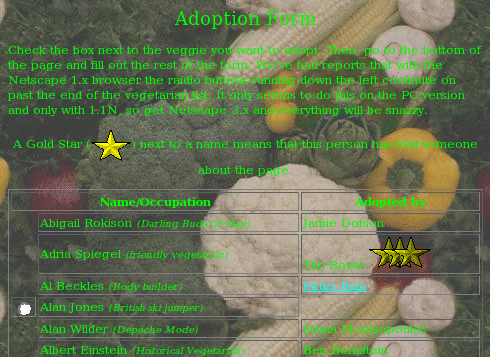
I was just digging through some old files, and I came across my first web pages. They were hand written HTML done in late 1995. Among the worst of them design-wise was my 'Adopt a Vegetarian' page. It was a joke started in October 1995 wherein non-vegetarians would "adopt" vegetarians and agree to eat twice as much meat, so as to balance the vegetarian out.
The Adopt a Vegetarian website was up before most of the world had even heard of the web, and certainly before folks learned not to take anything on-line too seriously. The volume of vitriolic hate mail I got was amazing. I wish I'd have saved them. The site existed during the period when the mainstream press was writing a lot of "gee whiz, look at this crazy website" articles. I ended up getting written about in a few different publications including Der Spiegel (wikipedia), which I've got clipped and stored somewhere.
Anyway, I re-rendered the site for the first time in ages, and here's a screen shot to that monument of bad taste in both design and humor.
Tags
- funny
- java
- people
- python
- mongodb
- scala
- perl
- meta
- mercurial
- home
- security
- ideas-built
- ideas-unbuilt
- software
Contact
Content License

This work is licensed under a
Creative Commons Attribution-NonCommercial 3.0 Generic License.